
Introduction
The contents of this post are mainly subjective claims and anecdotes regarding my experience of LOW-CARB NUTRITION as it relates to a recreational athletic lifestyle. The opinions offered are my own and to a lesser extent, my wife’s, but they’ve been formulated on work and advice from respected professionals and academics active in the fields of sports, physiology, nutrition etc.
Hopefully, I’ve interpreted that advice correctly but, even if I haven’t, the results have been entirely satisfactory as far as I’m concerned. I’ve tried to avoid making absolute truth claims because, although I might be convinced by our own experiences, I can’t be sure that they’re universal. As I’ve said before, I’m not a health professional but I think I’ve got a reasonable grasp of the basic theory behind human metabolism and nutrition.
Why the switch?
To reprise briefly what I said in Part 1 of what I think is now going to be a 3-part series: about thirteen years ago I’d started to become uncomfortable with my “conventional” diet particularly as it related to my interests in running, cycling and hiking. This led to a few years of eating what I describe as a “meat-free Mediterranean diet”. While my weight was firmly under control other issues persisted while more appeared to be emerging. So, in 2018 we switched to the ketogenic or — as I prefer to call it — low-carb diet.
On learning about it, it immediately struck me as the way in which our early ancestors might have eaten in the millions of years before they learned to cultivate grains. It certainly seemed capable of sustaining hunter-gatherers through the harsh winters of a temperate climate. Supporting this conviction was a nagging idea that processed carbohydrates — sugar and grains — have been linked strongly with the inflammatory health conditions that could thwart my desire to remain active as the years begin to accumulate.
Transitioning to low-carb
While many people switching to low-carb do it gradually, WE WENT ALL-IN. After doing our research we simply stopped eating the main forms of carbohydrates: sugar, grains (rice and pasta) as well as most fruit and vegetables including what, for me, were the “big two” — bananas and potatoes.
The first couple of weeks were a struggle when it was hard to muster the energy to stand up and walk, let alone run; my wife however, seemed to respond a bit quicker than I did. It’s the period that the media often refer to, somewhat dramatically, as the “KETO FLU”. In my opinion it’s an unfortunate and profoundly unhelpful overreaction that in itself can dissuade people from trying the diet. Yes, we felt a bit drained and/or fatigued for a few weeks but it was interesting rather than injurious.
Progress thereafter was rapid with the two most notable features being an ABSENCE OF HUNGER and a STEADY SUPPLY OF ENERGY. Both continue to this day though it’s important to note that I feel as tired as ever if exercise and sleep aren’t properly balanced. CRAVINGS CEASED, particularly for sweet food; there was NO NEED TO EAT DURING EXERCISE, regardless of duration or intensity; I felt SHARPER ALL DAY with NO MID-AFTERNOON SLUMP. There’s a popular claim that “BRAIN-FOG” DISAPPEARS but I can’t say that I ever had it to start with.
Keeping a Diary
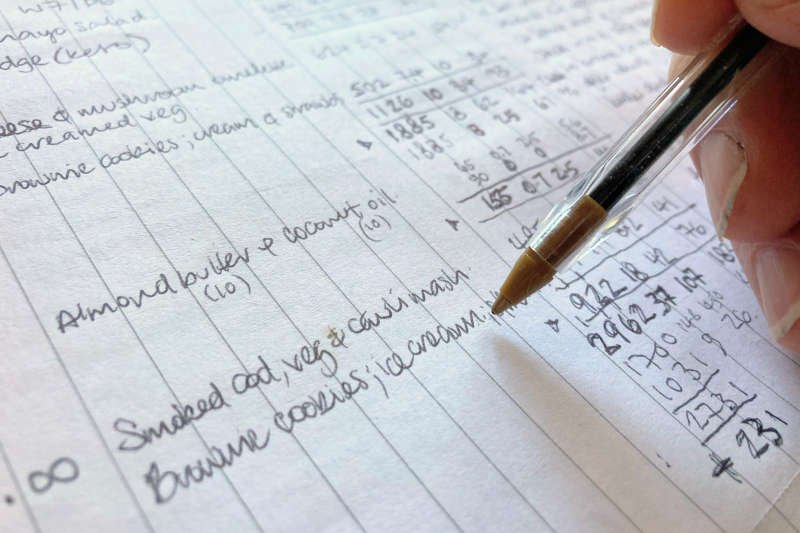
For over a year before and after going low-carb I kept a detailed FOOD DIARY where I weighed and broke down into its component groups EVERYTHING I ate and drank. Admittedly, it’s a bit more than many would be inclined to do but my diaries remain ever useful resources that I’m pleased I took time to record. I stopped writing them because eating more simply, more consistently and less frequently meant I became so familiar with the metrics that there was little point. It probably says something about the diet itself that A LOW-CARB DIARY IS MUCH EASIER TO MAINTAIN.
Reading from the diary, we switched to low-carb on the 20th May 2018. At that point I weighed 65-66 kg and was training with my local triathlon club. Initially my weight dropped as it’s quite common to lose the water associated with carbohydrates. Eventually I stabilised around 63-64 kg depending on how much I was training. My fat measurement, which I’d taken for years (with the same cheap pair of calipers from a skin-fold above my left hip) was consistent at 3-4 mm. Comparing body fat images on the internet I’d say I was somewhere between 12-13%.
Seven years later, my weight’s stabilised around 69 kg. I believe it’s increased muscle mass from differently focused training over recent years (cycling, running, hiking and gym work). Perhaps it’s also from better quality protein intake. I still measure the same skin-fold which is now 4-5 mm, so a tiny, but stable, increase in fat. As a rough estimate, I’d say I’m now between 13-15% body fat. There’s also the effects of ageing to consider.
Measuring Metrics
We paid for three years of annual BLOOD TESTS which have proved to be very useful for comparison year on year and which I’d definitely recommend. We bought ketone, blood sugar and blood pressure monitors and — as I’ve always done — I continued to take a keen comparative interest in my stools and urine. Seven years on, all appears to be good.
At the beginning we measured ketones in virtually every circumstance, in the morning, before and after meals, before and after exercise — even when we were on holiday. After some interestingly inflated numbers in the first few weeks (3-5 mmol/L) we both declined to much lower levels, typically less than 1 mmol/L depending on how much we’d exercised and/or eaten. Neither of us measures ketones routinely anymore because — like the food diaries — the results are so predictable.
Weight Management
While the individual emphasis on core activities of hiking, running and cycling has changed year-on-year, I’ve managed to maintain a fairly consistent regime of eating, exercise and recovery — in roughly the same proportions month-on-month. Given that I had plenty of experience before low-carb I can say with confidence that REMOVING CARBOHYDRATES HAS MADE WEIGHT MANAGEMENT MUCH EASIER. Losing weight is now something I do only if I’m preparing for an event that might benefit from it. While it might seem obvious, if I exercise more and eat the same, I weigh less and vice-versa. It was never as simple on carbs.
Fasting
I’ve found that INTERMITTENT 24-HR FASTING is a useful way to control weight. It’s particularly easy for us to implement because we LACK THE FOOD CRAVINGS that are a feature of a conventional carb-rich diet. A key feature of a low-carb diet in my opinion is the SATIETY associated with more efficient fat oxidation; this makes the process of fasting a breeze.
Without the cravings typically induced by processed foodstuffs it’s EASY to increase the gap between meals — something that’s generally held to be a good thing in most diets. If we’re out hiking for the day it’s common to go 24 hrs between evening meals with nothing consumed in between and lacking any drive to do so. It’s just as easy not to over-eat. Weight drops consistently and predictably during each 24-hr fast. As a very rough rule of thumb, taking hydration into consideration, I expect to lose 1-2 kilograms. If I persist — and it’s quite easy to do it — the weight reduces predictably, modulated by exercise.
Soon after starting low-carb I ended up fasting for 56 hours. My weight dropped to 62 kg, the lowest I’d ever been while exercising with full motivation. It had started as a 24-hr fast that didn’t stop: the longer it went on the easier it became. I eventually pulled the plug because I found being able to see every single rib slightly disturbing. I was 55 at the time and running as fast as I’ve ever run. I’ve always described myself as a “decent club-runner” slowly getting better within my age group. Fasting with low-carb illustrated, for me, the importance of the RELATIONSHIP BETWEEN WEIGHT AND PERFORMANCE.
Although I weigh more today and my times are a bit slower — though not excessively — the extra weight is mainly lean mass with a tiny bit of extra fat. However, I’m at a point in my life where I’m focusing more on retaining muscle to facilitate the LIFELONG GAME I’m most interested in playing.
Advantages of Low-Carb Nutrition for Activity
Here are some of the key features that I find compelling about ketogenic/low-carb nutrition with respect to the athletically active lifestyle that I hope to sustain for as long as possible.
Weight Control
Removing carbs from the equation makes it much EASIER TO CONTROL WEIGHT independently of exercise. Consuming carbs elevates blood glucose and decreases fat burning meaning that stored fat remains largely where it is until glucose levels drop (it’s insulin really, but blood glucose will do for now). If glycogen reserves are replete, excess glucose is converted to even more body fat. I find I can predict weight loss quite accurately over the course of a session.
There was a time, on returning from a long bike ride, that I’d want to eat IMMEDIATELY (dates and cereal were my go-to products). Low-carb removes that compulsion entirely, particularly after exercise. Typically I leave it until the next meal or whenever feels appropriate as there’s a complete ABSENCE OF CRAVING. I don’t even think about it these days. Like SATIETY it’s a key feature of the diet in my opinion — a feature almost always IGNORED by “experts”, as though energy balance was the only game in town. Imagine that you’re continually being drip-fed calories, except that they’re mainly from your OWN RESERVES and not an external source.
Fat For Fuel
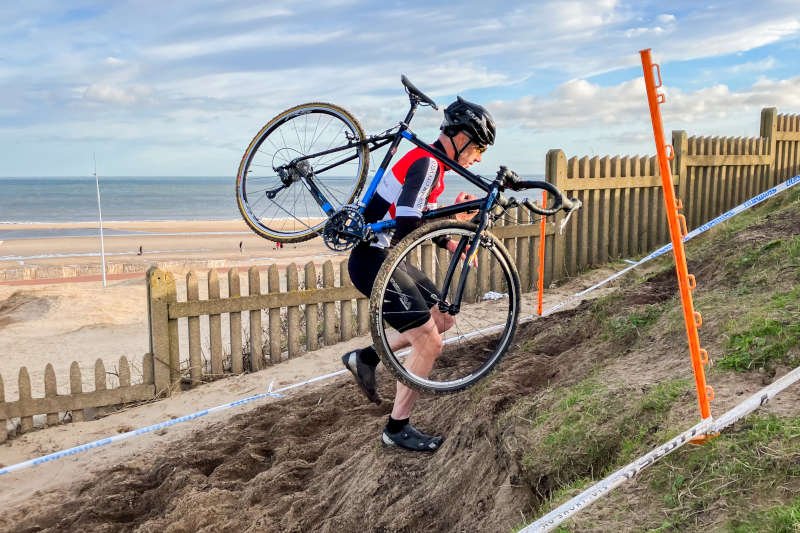
Apart from general health issues, the idea of using FAT AS A PRIMARY FUEL FOR EXERCISE has always been my main motivator. Conventional dietary advice gives the impression that the ONLY way activity can be fueled is by consuming EXOGENOUS CARBOHYDRATES (glucose consumed DURING exercise rather than broken down from stored GLYCOGEN). In fact, it’s quite common to see short duration activity, like cyclocross races for example, fueled with gels.
Using highly processed carbs (sugars) and other additives might be the optimum strategy for elite racers where money, status and lifestyles are at stake. Maybe even at lower competitive levels too. My problem is that the quantities advocated (>100 g/hour) can’t be tolerated by many and possibly most stomachs. For me, this is a massive “red flag” that I think is likely to have long term health consequences. Neither am I keen to consume stodgy dough and pastry during the course of my activity as many cyclists do in long endurance events.
Keto-Adapted Athletes
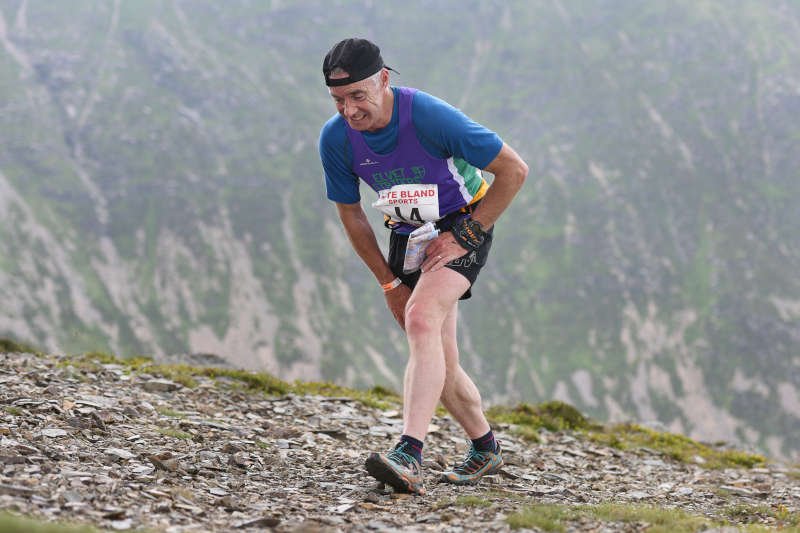
There are only a handful of studies involving athletes using a ketogenic/low-carb diet, none of which I’d consider to be fully KETO-ADAPTED. The threshold for keto (or fat) adaptation is typically seen as around 2-4 weeks which, from my own experience, is MONTHS short of one’s potential. With some notable exceptions most studies have been designed to focus on the PRIMACY of carbohydrate consumption.
My own humble metrics suggest that it’s possible and, I believe, healthier to perform at a good athletic level, across all training zones, on what amounts functionally to ZERO CARBS. As an older athlete, I’m concerned that carbohydrates — the macronutrient shown to be most closely associated with inflammation — are likely to both impede athletic recovery and degrade general health.
A standard model for exercise fueling indicates that more fat is oxidised at lower exercise intensities, up to and around 65% of VO2max (a fairly easy pace). This falls off to virtually zero as the effort becomes anaerobic. Because most people consume carbohydrate as their main macronutrient, the implication is that it’s IMPOSSIBLE to fuel higher intensity exercise over long durations (say in excess of 2 hrs) WITHOUT USING EXOGENOUS CARBOHYDRATES. It’s an idea that I believed for a long time as a low-carb athlete, despite my experience to the contrary.
In the 7 years that we’ve been low-carb (and I consider myself to have been fairly disciplined about it) I’ve competed in many events, from flat-out 5K runs to 1000 km cycling audaxes. At 63, I still expect to finish in the first half of the field of a typical recreational event and be considerably further up my age group.
Because I’d like to continue into old age, or for as long as possible, I believe I need a WHOLESOME AND NUTRITIOUS diet together with other lifestyle factors including sufficient good-quality SLEEP. Such a diet, while supplying sufficient energy, would keep my metabolism stable, nurture ageing tissues and promote recovery thereby allowing me to train regularly and with CONSISTENCY.
Metabolic Stability
I function more PREDICTABLY than I ever did on carbs with particular regard to DIGESTION, ENERGY LEVELS & RESPIRATION. As I’ve indicated above, one of the most obvious and severe limitations of consuming excessive amounts of processed carbs is that the “average” gut gets to a point where it can no longer handle it. Nausea can lead to vomiting which introduces hydration/electrolyte issues during which time the body still requires fuel to exercise. A difficult situation to manage.
I should confess that I’ve never thrown up, on carbs or off them, while exercising or afterwards — but I’ve been close. Now it’s no longer an issue. Acid reflux was a more significant problem for me, which I only tend to remember when I get the occasional bout today. The difference is that, like the indications of an empty stomach, it lasts for no more than a few seconds.
I don’t take medications where I can possibly avoid them and to date that’s meant ANY medications. Antibiotics and antacids are known to compromise the gut microbiome so they had to go, while I’ve decided to save the antibiotics until I might REALLY need them. My gut is consistently stable and I rarely feel the need to go to the toilet outside of my regular routine or during an event.
I sometimes experience the occasional “energy slump” however which I associate with some sort of “switch over” in fueling substrate (it’s probably not but I can’t help thinking of it that way). It typically happens well into a ride, maybe during an effort — I can’t really say — but isn’t significant enough to have a noticeable effect on performance and doesn’t last long.
Also, I BREATHE MORE QUIETLY during exercise. I’m not saying that this is significant because anaerobic efforts feel as uncomfortable as they ever did. Now though, if anyone’s gasping in a race it’s not me. I mention it because one of the most profound effects of discarding carbs, as far as I was concerned, was the ability to take what I considered to be a “full” breath. I’ve mentioned this before but for a couple of years I’d been concerned that I hadn’t been able to do it. Association isn’t causation but they were perfectly coincidental; since then I breathe as deeply as I need to.
Reduced Hydration Requirement
This has become more of a thing since I went low-carb but to be honest I’ve never followed the received wisdom relating to hydration for exercise. It’s always been my practice to drink (water) as much as I need, when I need it, rather than preloading and/or pre-empting. That strategy might change when it’s hot and humid but otherwise I rarely touch my water bottle (I served in the Territorial Army in the early 80s, when it was strictly FORBIDDEN to drink without being told). I had a minor, performance-compromising disaster a couple of years ago, which I wrote about in Part 1, but apart from that can’t remember ever having had a problem.
On a somewhat trivial note there’s a performance benefit that COULD be gained by not carrying potentially over a kilogram of water around. That’s a judgement that everyone needs to make for themselves on the day of course. When I’m running, on the UK’s upland fells for instance, I carry a small cup on my belt to drink directly from fast-moving streams. Many don’t like the idea but I’ve done it for years with no problems. In “normal” conditions in the UK it’s more than enough but it’s another call you make for yourself. Other than when I really need it for hydration, water is most useful for combating the effects of an empty stomach, what we call “ghrelin growls”.
A quick word about SALT: I prefer my food well seasoned and always have done. I don’t use electrolytes in water since adopting a low-carb diet. Even in hot weather I’m not predisposed to cramping although it happened frequently on carbs. Whenever I’ve experienced cramps in recent years, it’s typically been in bed, in association with weight loss. So, to be clear, I DO take quite a bit of salt but only on food at mealtimes.
Extended Endurance
I guess this is one of the most important features for anyone who considers themselves an endurance athlete. Apart from biomechanical fatigue I haven’t yet hit a limit on the distance I can go before NEEDING to eat. I use small amounts of food, typically cheese, nuts, meats and maybe cherry tomatoes (a small handful every few hours) to ward off what I’ve already referred to as “ghrelin growls”.
Bearing in mind that I’m not usually racing, I’m able to work as hard as I want for as long as I want (my motto is “flow, not slow”). The last time I got “the knock”, “bonked” or “hit the wall” was pre-2018 since when I’ve never been hungry. Another advantage of using fat for fuel — particularly in non-competitive activities — is that THE LONGER I EXERCISE, THE BETTER I FEEL, the primary limiting factor being musculoskeletal rather than energetic or cardio-ventilatory.
Neurological Benefits
For many, the generation of KETONES from nutritional ketosis is the MOST important feature of the ketogenic/low-carb diet. It’s thought that the brain actually functions BETTER using ketones but is denied them because a conventional diet means there’s a constant supply of glucose.
Although my major interest is in FAT UTILISATION I’m more than happy to benefit from ketones. Elevated levels of ketones ensures that the brain always has its energy needs met, hence no “hitting the wall”. To repeat what I said above, the last time I got “the knock” as a cyclist was pre-2018. It’s just as much of an advantage in day-to-day life too. Assuming I’ve had enough good quality sleep, my concentration is always good nor do I feel drowsy in the afternoon like I used to.
Simpler Organisation & Flexibility
I’ve long since taken for granted the ability to set out on an activity without worrying about what and how much food to take — “when did I last eat?” or “did I remember to bring any money?”. Exercise is much simpler without the stress of having to fuel on the go. I’ve already written about what I might take on a long bike ride and why I take it but most of the time I don’t bother with anything at all. I NEVER take anything on a run but when hiking we’ll sometimes put together a low-carb picnic, just because it’s nice.
Improved Recovery
This is probably number two in my list of favourite benefits. Burning ketones in place of glucose is considered to result in the generation of fewer ROS (Reactive Oxygen Species or “oxygen free radicals”). They’re a by-product of exercise stress, causing damage to cell membranes, promoting inflammatory responses and reducing insulin sensitivity.
While the body produces its own anti-oxidants, having fewer ROS in the first place ensures that it’s less likely to be overwhelmed and that recovery is optimised. My experience of the improved recovery is that, following a long run the day before, I went from shuffling sideways up and down stairs to walking normally, multiple stairs at a time. The only thing that changed was my diet.
While no-one would describe me as a gymnast, my bodily range of motion (ROM) has also benefited from the cessation of inflammatory issues and is at least as good, if not better, than most people my age. I also believe that my tissues have become more resilient: I used to be plagued by old ankle and calf injuries; although they haven’t disappeared, they’re extremely manageable these days. Consequently I’m able to train more consistently which means better fitness for sport (my heart rate reserve is well in excess of the generalised “220-age” rule).
Better General Health
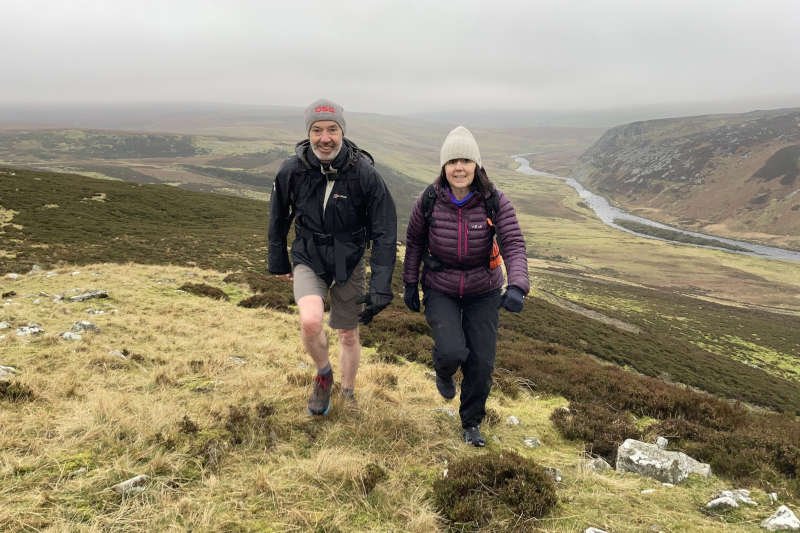
Overall I experience CONSISTENT WELL-BEING in that I have no persistent problems to speak of (if you ignore my left ankle, right calf and dodgy lower back!). I get no more than my fair share of flus and colds and throw them off reasonably quickly (I’d say we get fewer but I can’t quantify it). I’ve said before that I don’t take medications nor do I feel inclined to moan about illnesses. I know they’ll pass fairly quickly so try to stay quiet and let my body sort it out itself. Seems to have worked so far, and not just on low-carb.
Previously carb-fuelled issues like my gums bleeding, hair falling out and nails cracking all stopped. Discomfort in my joints disappeared COMPLETELY and I could inhale right to the “top of my lungs” an ability I felt had been lacking for several years. I have minimal gastro-intestinal distress these days (bloating; stomach upset; constipation/diarrhoea) though I’d admit to having had a couple of REALLY nasty bouts in recent years. Since giving up processed carbs I’ve also had a clean bill of health from my dentist. This is quite important because dental decay correlates strongly with inflammatory conditions elsewhere in the body.
Disadvantages of Low-Carb Nutrition
Social Eating
I don’t want to sound glib but social eating is about the ONLY downside to low-carb I can think of. I daresay that eating socially is important for most people even if I’ve never been a big fan myself. While restaurants might be able to offer something for vegans, virtually EVERYTHING on a conventional menu either comes with, or is completely integrated with, carbohydrates. I don’t like waste, I don’t like poor value for money, nor do I enjoy eating when I’m not hungry so I’m never too bothered about eating out.
Being more social than I am, my wife eats out quite a bit. She’s more instructive about what shouldn’t be on the plate and can usually find something on the menu that she’s happy with given the metabolic flexibility she’s developed. With a little planning it’s possible to have it both ways if you want it. Some, in keto circles, say that “the dose is the poison” meaning that “problematic” foods, in small, infrequent quantities aren’t necessarily a problem once you’re keto-adapted. I’d generally agree but, for many people trying a low-carb diet, it would be easy to slip back to old ways from that position.
What affects ME most — in terms of hospitality outlets — are the cafe or pub stops beloved of most cyclists or hikers. Generally it’s only drinks we require and yes, both of us still drink alcohol, though in small quantities (usually a “half” of either cider or a decent ale at a pub stop). I think I prefer pubs as I don’t like to take up a table in a cafe for such a low spend. If it’s busy we might have soup or anything that’s reasonably low-carb (eggs are a good start but they’re not as often on the menu as you might imagine). If it’s cold and/or wet then we’d be more inclined to have something to warm up.
I think we both agree that neither of us feels BETTER for having eaten; I just feel “fuller”. Some tastes linger uncomfortably, some will repeat and I frequently feel less inclined to do any hard work after having eaten. Soup is always the best option if it’s not too carby or spicy. If it comes with a small amount of bread — artisan and preferably toasted — I’ll eat that but otherwise I leave it. These days, even the nicest bread tastes to me like flavourless blancmange.
One aspect of a low-carb diet that continues to amaze me however, is that I CAN SEE AND SMELL FOOD WITHOUT A PHYSICAL OR EMOTIONAL REACTION. I can look at cakes in cafes and watch people eating ice-cream but have no desire to do so myself. If you had any idea how much I once enjoyed the most sickly-sweet desserts you’d realise the near miraculous implications of what I’ve just written!
Low-carb in Action
“Chase the Sun North” 22/06/19
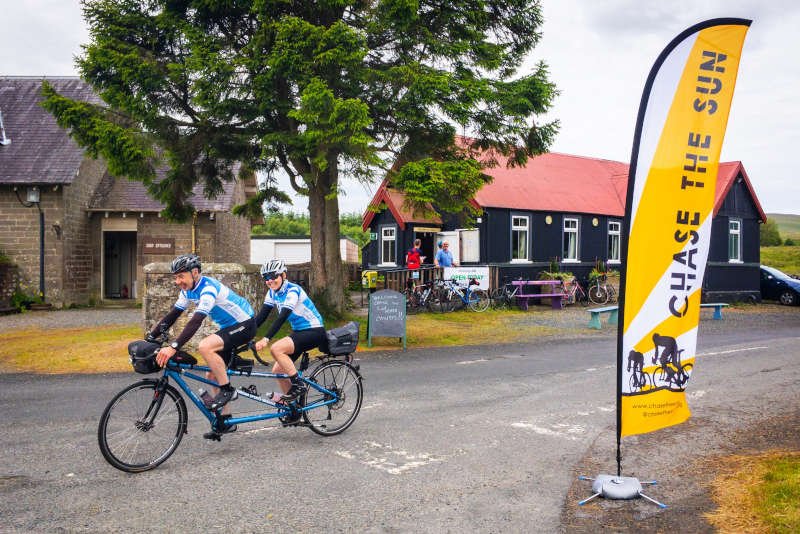
Our first low-carb cycling event, about a year after we switched, was this cycling challenge which we did on our tandem and was the first video I posted on YouTube (that’s us in the feature picture at the top of the page; you can also check out our GOOGLE GALLERY). It required 200 hilly, eventually hot miles between Tynemouth (England) and Ayr (Scotland) to be covered between sunrise and sunset on the longest day of the year.
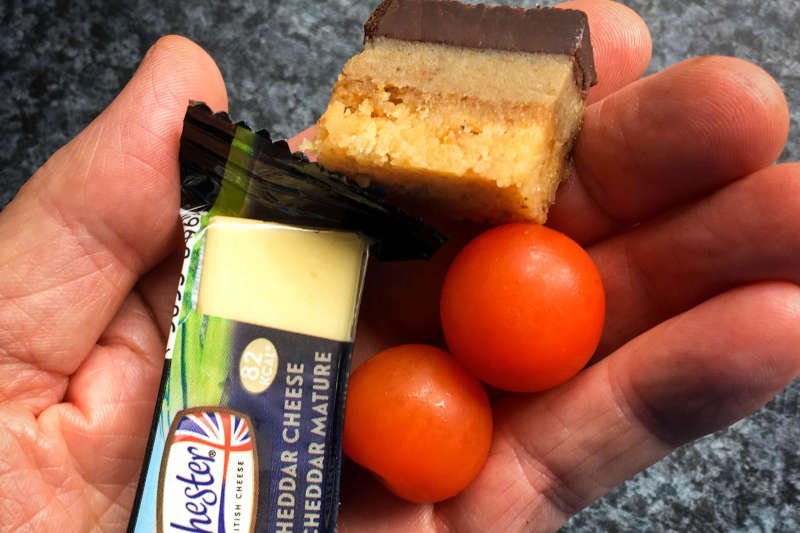
Once upon a time I’d have done an event like this with pockets full of gels and bars, bottles of energy drink, a couple of cafe stops and possibly calling into a food store en route. Rattling around in our cavernous bike bag on this occasion, we each had a couple of small, individual cheeses, a few cherry tomatoes, a quarter-slice of home-made, low-carb pizza and a small cube of home-made, low-carb caramel square (pictured) which, although very nice, we no longer eat. Drinks all day were water, coffee and tea.
Neither of us ate it all. As we’ve come to learn, a few pieces of simple food is all that’s needed. The truth is we never really thought about eating, avoiding in the process, any potential side effects that could have compromised a long, hot but still comfortable day out on the tandem. We made it to Ayr in around 15 hours with plenty left in the tank, happily inside the first half of the field.
Training Run 29/07/25
To bring things up to date I decided to take a few metrics for a typical long-run training session. This one was a 13-mile, undulating, multi-terrain run around Durham at a moderate pace with our 33 year old son who’s training for the Great North Run. It’s on Strava as is everything else I do.
As usual I’d had nothing to eat since dinner the previous evening. For the belated purpose of recording it here, I weighed myself to find that I was 71.1 kg, a little on the heavy side but hardly surprising as I’d had a couple of cups of coffee, a glass of kefir and hadn’t yet been to the toilet. We set off from home around 10 am and when we returned — a very warm couple of hours later — my weight was 69.8 kg. This was roughly as predicted as I reckon on losing about 1 kg/10 miles of steady running in “average” temperatures.
I also decided to measure my ketones which I don’t usually do anymore. These were 1.2 mmol/L, quite low but even so, a little higher than I’d predicted they might be. In comparison, our son’s were 0.7 mmol/L. Although he doesn’t follow a low-carb diet he frequently runs fasted (as he’d done today) so I wasn’t particularly surprised that his values were lower than mine. My reading tells me that keto-adapted athletes quickly burn the ketones produced from lipolysis.
My blood glucose was 5.6 mmol/L, a fairly healthy number after 2 hours of strenuous exercise compounded by heat. One of the big advantages of low-carb, as I’ve already said, is that it’s glycogen-sparing: you just don’t run out of glucose (or at least that’s been my experience). I recall that my son’s glucose numbers were slightly lower than mine.
For lunch, a couple of hours afterwards, I had courgette and stilton soup, some kimchi, a couple of small, thin slices of keto-bread, thickly buttered, and another glass of kefir — all home-made and ready to be shared on The Durham Cow.
Summary
So what’s the takeaway, if you’ll forgive the pun? Well, low-carb isn’t for everyone. I’m surprised at how many folks, including fellow athletes, are completely unmoved by the idea that sport can be done without exogenous calories (no gels or pies or cakes or whatever). What still feels to me like a super power fails to flicker with them. I guess people just LOVE pizza and pasta…and bread…and rice…and chips…and cakes…and ice-cream… Me, I love not being ruled by my stomach.
It’s great also having no inflammatory aches or pains (apart from old injuries which I believe would be much worse if I were still on carbs). I love quicker recovery from illness, injury and exercise and I love not having so many colds, flu or gastric upsets. Assuming I get enough sleep and don’t over-exercise, I love having constant energy and endurance. I STILL LOVE FOOD while not being emotionally browbeaten to consume an excess.
The main macronutrients in our diet — protein and fat — have most of the texture and ALL OF THE TASTE while the carbohydrate sources we’ve cut out have NONE. We don’t have to eat nearly so much to get the nutrients we need. The old myths associated with fat — including the much vilified SATURATED FAT — are based on poor studies that have long been disproved. The best objective science dealing with fat is MUCH MORE INTERESTING. Regardless, I wouldn’t dream of telling anyone what they SHOULD eat, that’s for each of us to decide for ourselves.
As a bare minimum I’d EAT FRESH and avoid ALL highly processed foodstuffs, particularly those that contain SUGARS and have been COOKED IN SEED OIL — which rules out just about everything with an ingredients list unfortunately. Oh, and I’d also continue to FAST frequently (16-24 hrs). I’ll stop there for now but next up, in Part 3, will be an overview of what a keto/low-carb diet looks like for us, along with a few of our favourite recipes.